Our Story
A Note to Our Readers:
The Sommelier Society of America is currently engaged in an ongoing research project to document and preserve its rich institutional history. This section draws from archival materials, contemporary press coverage, and internal records, and will be updated periodically as additional information is verified.
Research to date has included materials from the New York Public Library, historical newspaper archives, and firsthand accounts. Archival references and a general bibliography are available on the Archival References & Links page.
If you are an SSA alumnus, former member, or have documents, photographs, or firsthand recollections related to the Society’s history, we welcome hearing from you.
Carrie Puchkoff
Director of Operations
Origins of The Sommelier Society of America
Founded in 1954, the Sommelier Society of America began as a membership organization for restaurant professionals in New York City. According to early accounts, a group of highly knowledgeable waiters at the 21 Club sought to formalize their wine expertise, not only to share knowledge and experiences, but also to elevate professional standards and improve wages and gratuities within the dining room. What emerged was a society grounded in peer learning, professional identity, and advocacy for wine service as a skilled discipline.
In 1960, the Society established the Wine Captain’s Seminar, created specifically to train restaurant personnel. The Seminar formalized instruction in wine knowledge, service standards, and blind tasting, and became one of the earliest structured professional wine-training programs in New York City. Enrollment required active membership in the Society, with membership extended by recommendation, reinforcing its identity as a professional organization rather than a general education course.
By 1980–1981, the Wine Captain’s Seminar expanded beyond the trade and opened to consumers, reflecting a growing public interest in formal wine education. Membership remained a requirement for enrollment, maintaining continuity with the Society’s original structure even as its audience broadened.
By the early 2000s, the Society’s membership model became largely dormant. As trade tastings proliferated and wine education became more widely accessible, the Society’s emphasis shifted away from formal membership and toward education, certification, and structured coursework, aligning with broader changes in the wine industry while maintaining its professional foundations.
The Wine Captain’s Seminar in Practice (1960s–1980s)
By the early 1960s, the Wine Captain’s Seminar had become the central educational offering of the Sommelier Society of America. Designed expressly for restaurant professionals, the Seminar combined formal instruction with tasting-based evaluation, reflecting the practical demands of wine service in New York dining rooms.
Classes were structured as a multi-session course, typically running 24 to 25 weeks, and were offered once per year, with sessions beginning in September or October. Courses were taught by working professionals from the wine trade, with instructors changing weekly. This rotating faculty model exposed students to a wide range of perspectives across regions, styles, and segments of the industry, while anchoring instruction in real-world experience.
Each session included guided tastings, generally five to six wines per class, with wines contributed by the trade, underscoring the Society’s close relationship with importers, distributors, and producers. Instruction emphasized wine knowledge, service standards, and sensory evaluation, with students receiving written materials and, in some periods, quizzes tied to lecture content.
The Seminar culminated in a final examination, which included a blind tasting component. Successful completion was required in order to earn recognition through the Society, reinforcing the Seminar’s role as a professional training and certification pathway, rather than a casual or purely academic course.
Throughout the 1970s and 1980s, the Wine Captain’s Seminar appeared regularly in New York newspaper course listings, where it was described as a professionally oriented, multi-session program focused on wine service and tasting.
The Sommelier Society of America in the Public Record
The following excerpts from The New York Times and The Washington Post document how the Sommelier Society of America and its educational programs were described in contemporaneous newspaper listings and wine coverage.
Building on the Society’s origins as a New York–based professional organization and the establishment of the Wine Captain’s Seminar in 1960, these listings provide a practical picture of how the course functioned during this period. They reflect a structured, multi-session program taught by members of the wine trade, typically offered annually, meeting weekly for 25 sessions, with limited enrollment, contributed wines, and evaluative examinations. While originally created exclusively to train restaurant personnel, by the early 1980s the Seminar had opened to consumers through Society membership, reflecting broader interest in formal wine education while maintaining its professional framework.
Contemporary press coverage also underscores New York City as the center of the Society’s leadership and activities. A 1981 Washington Post article notes the introduction of the Wine Captain’s Seminar in Washington, D.C., identifying the Society’s offices and leadership as New York–based and framing the Washington program as part of expansion efforts directed from New York.
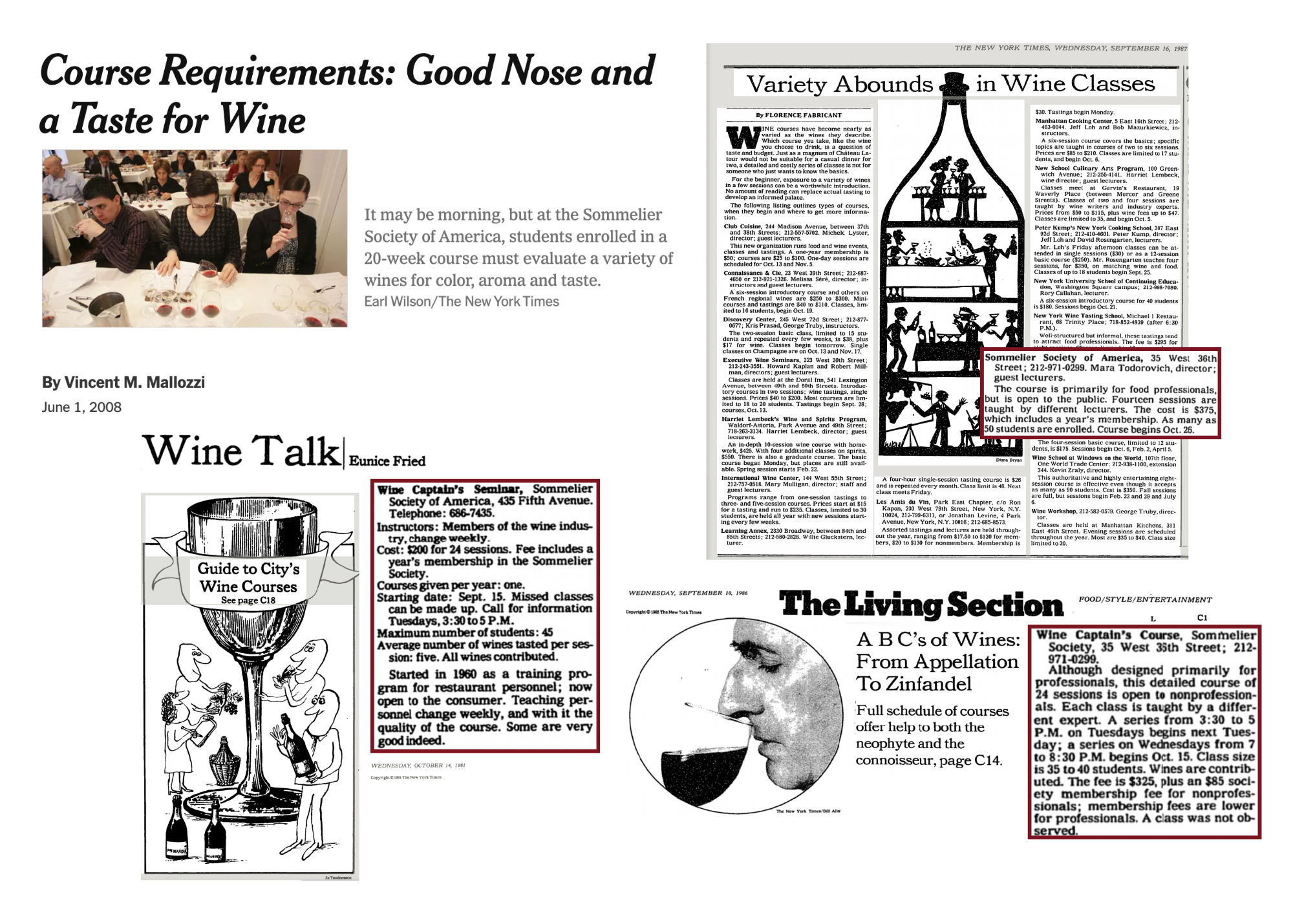
For a selected and ever expanding list of newspaper archives, click on the image above ⬆️
Locations and Physical Footprint
From its early years, the Sommelier Society of America operated within a series of New York City locations that supported its educational programs and administrative needs. These spaces served as classrooms, offices, and gathering points for members, grounding the Society’s activities in Midtown Manhattan over several decades.
By the 1960s, the Society was operating in Midtown Manhattan, with records placing SSA at 121 West 45th Street in 1967. By the early 1980s, the Society was based at 435 Fifth Avenue, an address repeatedly cited in The New York Times course listings during the period when the Wine Captain’s Seminar expanded to include nonprofessional participants.
By the mid-1980s, press coverage places the Society at 35 West 36th Street, where the Wine Captain’s Seminar continued to be offered through the late 1980s.
During this same period, contemporaneous press coverage documents a Washington, D.C. program associated with the Society. A 1981 Washington Post article notes the introduction of the Wine Captain’s Seminar in Washington, D.C., identifying the Society’s leadership and offices as New York–based and framing the Washington program as an extension of activities directed from New York.
From 1999 onward, the Society continued to operate exclusively in New York City, with its educational programs hosted at a succession of venues suited to classroom instruction and examinations. By 1999, classes and Society activities were held at The Williams Club, where programming continued through approximately 2010. Beginning in Fall 2010, courses were conducted at The University Club, a location used through Spring 2018.
In Fall 2018, the Society transitioned to Sud de France on Fifth Avenue, where classes were held until January 2020. From Spring 2020 onward, SSA programming has been based on West 54th Street, where the Society continues to conduct instruction and examinations today.
The Society Today
Across these later locations, the Society maintained continuity in its educational offerings while adapting to changes in venue availability and program delivery, including the introduction of remote instruction during the COVID-19 pandemic. In March 2020, all enrolled students were offered full refunds; the majority elected to continue the course remotely as local restrictions came into effect. Final examinations were administered in person under established safety protocols. The shift to remote and hybrid formats expanded flexibility and access for participants, a development that continues to inform the Society’s approach to instruction.
During this period, members of the trade also offered support, including the delivery of Champagne to students’ homes for a virtual seminar, coordinated by the then–U.S. Director of Champagne Bollinger.